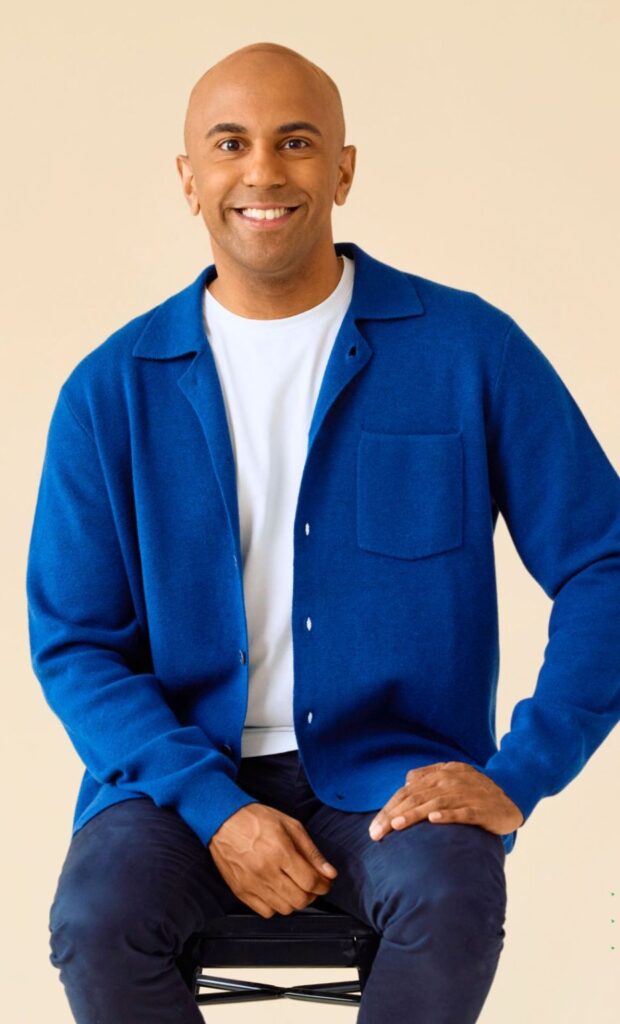
Public speaker and journalist Jehan Casinader is a MHW ambassador. The former TVNZ presenter has spoken openly about own struggles with depression and wrote about his challenges in his book, This Is Not How It Ends.
In Men’s Health Week Jehan spoke with HealthStuff, a dedicated digital health platform recently introduced by media company Stuff. The HealthStuff initiative aims to present easy to understand, reliable health information and advice. It’s worth checking out.
Prioritise what is important in your life
Why did you get involved with Men’s Health Week in the first place?
We’ve been raising awareness of men’s health for so many years now, and yet so often I meet men who haven’t been for a health check-up for years, or things they haven’t spoken to anybody about.
Unless we show them how to have these conversations and encourage them to prioritise their own wellbeing, they’re probably not going to do it. So anything that I can do to support that message, I’m happy to do.
Why are some guys so bad at coming forward about their physical health issues or their mental health problems?
We still have really deeply ingrained cultural narratives in New Zealand that tell men to bury their pain, their feelings and their concerns about their health.
Those old narratives around taking a concrete pill and hardening up — don’t be weak, don’t be vulnerable — are still really embedded in our culture.
I think there’s a difference between our rural and urban communities. You can sit in Auckland or Wellington and say, ‘We know all this stuff. We’re telling people to prioritise their wellbeing all the time.’ But if you’re on a farm out in Canterbury, you’re working by yourself, you’re not necessarily connected to other people for most of the day, and you’ve come from a background where you were told that you just needed to be tough.
You’ve been in the men’s health sphere for a few years now. Has the dial moved at all for guys talking about their mental health?
I think Gen Z is actually leading the charge on that. Often we hear Gen Z described as the ‘snowflake generation’, but I think they’re actually just showing the rest of us how to prioritise what’s important in our lives.
They have much better boundaries. They are more emotionally open. They’re better at articulating their needs, and they are focused on, ‘How do I get my work to support my life?’ rather than the other way around.
I think that’s challenging for a lot of older people because they grew up with the opposite story. Sacrifice your health, sacrifice your wellbeing, do whatever you need to do to provide for your family, keep your employer happy. But I do think we’re seeing a cultural change.
There are a lot of weighty issues happening around the world — wars, the cost-of-living crisis, job worries. That must all be a factor too?
I think people feel cheated. During the pandemic, we were told that we would get back to what was described as a new normal. So we waited for lockdowns to end, and then we waited for a vaccine, and then we waited to go back to work.
But then we had to deal with the impact of the Ukraine crisis and inflation, and changes in the housing market, and now there’s the Iran crisis. So I think people feel like, well, when is this ever going to end?
There is a cumulative fatigue when this continues year after year after year.
You’ve had a big personal journey yourself. Has your definition of strength changed at all?
I thought strength was defined by my ability to tough it out and to endure, whereas now I think strength looks like sustained performance — having a long, healthy life and career ahead of me.
Now, in my mid-30s, I am continuing to push myself, but pacing myself at the same time — taking time to actually get the basics right, things like diet, sleep and exercise, rather than flogging myself for a short-term goal.
How is your own mental health these days
My mental health is great. Te Whare Tapa Whā is the Māori model of health — the house with four walls. Mental, physical, relational and spiritual health are the four walls that hold up the house.
I’m really grateful to say that all four of those walls are stronger than they’ve ever been, but I still have rough patches, depending on what’s happening in my life.
To someone who may be struggling, what would be your advice to them?
Work out what the non-negotiables are. For me, diet, sleep and exercise are those.
Then there is social connection. A lot of men would say they have mates, but they don’t necessarily have friends, and to me there’s a difference. A mate is someone who’s in your life and who you spend time with occasionally, but a friend is someone you have more intentional conversations with.
Who are the people who are the actual friends in your life, and how can you catch up with them on a regular basis so that you can support each other through life’s challenges?
Get an annual health check. It’s one of the simplest things that you can do. So many of the preventable illnesses that men face occur because there was no opportunity for them to be picked up early.
And find something that you’re invested in outside of work. It could be a community, like a club, a sports team or a church, or it could be a hobby or a skill. Something that gives you a sense of purpose and meaning I think is really beneficial.
-Stuff